Released: 5th August
Seen: 17th August
Some movies are best watched with some kind of gimmick, it’s hard to explain why, but it’s true. I remember in a documentary of midnight movies that Roger Ebert said he couldn’t imagine a more boring experience than seeing Rocky Horror at home instead of in a theatre with all the trimmings that made it a midnight movie classic. Just a few years ago we all went to see Barbie and Oppenheimer as a double feature because it was a great gimmick. Sometimes we just have a private joke that we have to indulge in to watch a movie, it’s as simple as that… anyway, I decided to watch Big Chicken: A Fast Food Conspiracy while eating a 6 piece chicken order from KFC because I was curious if the movie was going to shock me so much I could fight the urge to finish that chicken, because that notion amused me and will now be the foundational structure of my review.
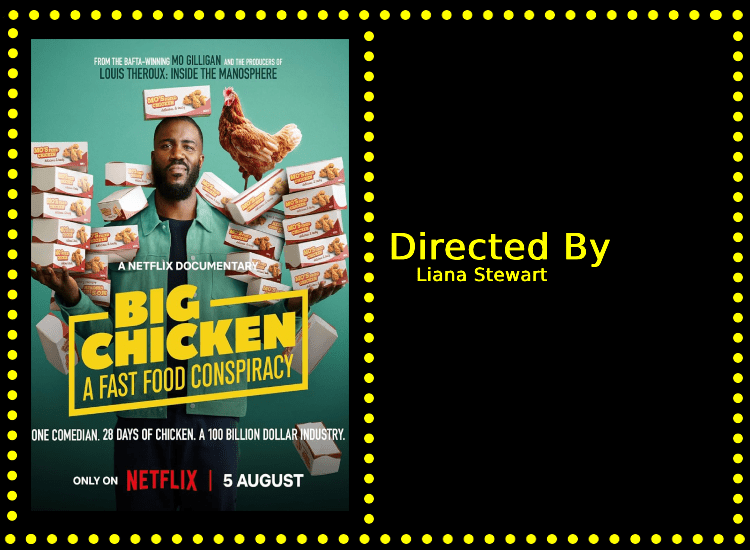
To get the standard “plot description” out of the way, Big Chicken: A Fast Food Conspiracy follows British comedian Mo Gilligan as he does a Super Size Me-esque story of only eating fried chicken for 28 days and seeing what impact that has on his health, while exploring the industry and the cravings that make this deep-fried poultry so enticing to so many. Along the way, he also touches on other cultural issues surrounding fried chicken before culminating in what we all kind of expect this film to culminate in: factory farms and how much they suck. This is intercut with reminders that this is all happening while he eats an insane amount of fried chicken for a month.
So the start of Big Chicken: A Fast Food Conspiracy (which is when I had the first piece of chicken) is honestly one of the stronger parts because Mo is, generally, great at setting a tone and getting setups ready for a punchline, which is what one would expect for a comic like him. He lays out the parameters of the experiment he’s doing, which is “No gym, no home-cooked meals and all meals must be fast-food fried chicken”. It’s a little basic in terms of setup, and the addition of “No gym” kind of means it’s set up to create the end result, but Mo sells it. He also sets up a ton of the issues that Big Chicken: A Fast Food Conspiracy will explore in more detail, kind of a thesis statement for the film that gets everyone on the same page and it’s all well presented. One thing that must be admitted about this film is that the presentation is, mostly, fantastic and all the key information is wonderfully explained so the audience can follow along.
By the time I got to the second piece, I could already see Big Chicken: A Fast Food Conspiracy kind of getting into a rhythm, laying out the facts and figures of just how big the chicken industry is. Because it’s something that you don’t tend to think about that much, the film goes to the effort of making sure the scope of this issue is real. It’s the little details that help make this film a little more interesting, the way it actually explores not just the scale of the chicken shop takeover in the UK but also makes it personal for Mo. It’s an unavoidable reality that Mo is a black man doing a film about fried chicken and he actually takes the time to interrogate that, how that’ll be perceived, that depressing history. Honestly, the most fascinating parts of the whole film are the moments where the cultural history of fried chicken is explored in great depth.
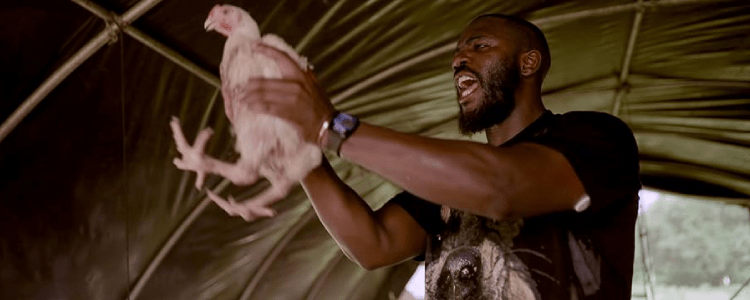
It’s around my third piece when Mo went to the US and honestly, Big Chicken: A Fast Food Conspiracy kind of turns into what you expect. If you read the plot and thought “This sounds a little like Super Size Me but with Fried Chicken” that’s because it is. You can almost feel the beats of that movie being hit over and over again, from the quick doctors visit early on to get a baseline to the sudden emergence of a medical issue (vomiting has thankfully been replaced with a lot of farts) to the shocking information that ingredient lists are sometimes hard to understand if you don’t know the names of chemical compounds. It’s at this point we start getting out information that, let’s be honest, anyone who has eaten food they didn’t personally grow has to know about. It’s also where you wonder how strict Mo is with the rules he laid out since it’s kind of implied that day 5 is a fried chicken bender. I’m not saying he was lying in the same way Morgan Spurlock was during Super Size Me (Turns out Morgan was drinking a TON during the making of that film, which explains why his results weren’t able to be replicated), but it does kind of make some of the latter moments in the film feel a little suspect.
Around piece four, I was regretting my personal little joke but not because I was feeling sickened by Big Chicken: A Fast Food Conspiracy, to be honest, the information in the film kind of stops being shocking and starts being “Mo learns about how capitalism has kind of fucked up everything” at some point and it doesn’t have much of a punch. The biggest impact that it seems to have is on Mo’s mental health and that’s another of the film’s genuinely great moments but it’s also when you start to notice a problem with the presentation. Big Chicken: A Fast Food Conspiracy likes to repeat information as much as it can, and not in a way that the audience can really get the point. It’s just occasional scenes of Mo calling one of his mates and telling him everything he’s learned, which we’ve just spent several minutes witnessing. It feels like padding and it really makes the film feel like it’s taking longer than it needs to.
It was at piece five I realised that this little personal joke I was doing wasn’t going to matter because realistically, Big Chicken: A Fast Food Conspiracy isn’t that shocking because it’s largely just telling us things we all basically know. We know that this food isn’t healthy but it’s also cheap and can feed a family which is why poorer neighbourhoods have more of it, we know that eating too much of it is going to harm the mental health of whoever eats it, we know about the companies that make it and their labour violations. It’s nothing new and it’s no more horrifying than we expected because most of this is just what most big corporations do.
Finally, as I finished the last piece, Big Chicken: A Fast Food Conspiracy picked up a little bit by actually talking about things like just what the chicken plants do to the people around them, the details are terrifying and some of the interviews are good but it keeps bumping into the dual issue of repeating everything for no reason and that this is all just Super Size Me but with a different lens. The stuff that could’ve made this film unique is basically over by the 30-minute mark, everything else… We know all this already.
Big Chicken: A Fast Food Conspiracy just doesn’t do enough to really explore the issue at hand in a way that we haven’t seen before. It’s information we already know, packaged fairly well but also packaged in a way that worked well 20 years ago but isn’t as impactful now. A lot of the bigger claims of the film can be answered with “Well yeah, obviously” because it’s all just common sense stuff. Big Chicken: A Fast Food Conspiracy is at its most interesting and effective when it actually deals with the cultural issues, the horrific history, the stereotyping, the fact that a food like this is sometimes the only option for people, that’s the stuff that makes you look at the bucket of KFC and wonder if it’s worth it but everything else… It’s stuff we know, it’s the devil’s bargain we made to enjoy a reasonably cheap container of chicken.
I expected that eating a box of chicken while watching Big Chicken: A Fast Food Conspiracy would sicken me, that I’d feel bad or not be able to finish it or just in some way regret the choice… but nothing in this film is so shocking that it’ll change minds, which is sad when it had the potential to really do something important.


