
Released: 16th November
Seen: 23rd November
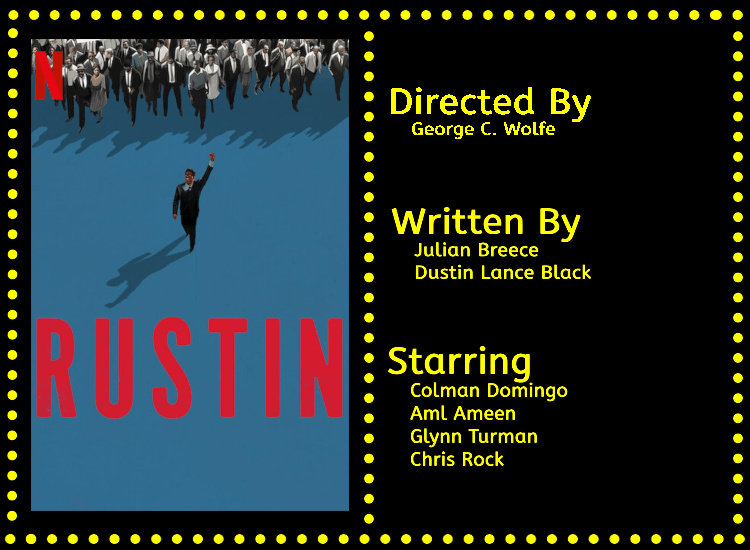
Bayard Rustin was born in 1912 and lived one of the most fascinating lives that you will ever skim through on Wikipedia. Raised as a Quaker, the man was openly gay back when that was a much more dangerous thing to be than it is now (and oh boy is it still dangerous now), he recorded several albums of gospel music, was at the forefront of many civil rights movements and even ended up adopting his lover in the 80s because they were unable to get married so had to do the most creative workaround ever to ensure they had their rights. The man is genuinely fascinating, someone who should probably have an entire docuseries made about his life but if you were to pick one event from his remarkable life to make a movie about it seems fitting that his work in organising the legendary march on Washington would be the focal point for the biopic Rustin.
Rustin pins the bulk of its focus on the few years before the march on Washington where Bayard Rustin (Colman Domingo) is trying to organise over 100,000 people to take part in the largest non-violent protest ever seen in order to try and end the scourge of segregation. Over the brief 106-minute runtime it shows the obstacles that fell in Rustin’s way, how his relationship with Martin Luther King Jr (Aml Ameen) changed over the years and how he was integral to teaching the new generation the methods of non-violence. Littered throughout the film are little moments that flashback to previous assorted demonstrations and moments of Rustin’s life and the entire film battles with his relationship struggles, namely trying to live as a gay man in the 60s when it could easily be wielded as a weapon against you.
Rustin avoids the big pitfall that a lot of biopics fall into by choosing to put most of its focus on one brief period of time instead of trying to fit an entire lifetime into the narrative of a film. This means that the very basic structure of the film works wonderfully, it’s an easy-to-follow narrative that fills in a few cracks of general knowledge surrounding the famous march on Washington which allows the central performance to shine as bright as possible. There isn’t any need to bounce around a timeline or worry about someone slowly aging through a role, it’s a simple and direct story that still has an impact today with our current political climate. If only we had a figure like Bayard Rustin around today to rally people to fight for justice, things might be better.

Speaking of that central figure, Rustin does follow one major trope of biopics and that is just being a showcase for the talented performer in the lead role. Colman Domingo is absolutely transcendent in this role and every single second he’s on screen you can feel the charisma that seems to just spray out of every pore of his being. It’s the kind of performance you can’t look away from, captivating in the quiet moments and jaw-dropping in the loud ones. Every single scene is a chance for Colman to absolutely dominate, delivering cutting one-liners or emotionally destroying with equal ease. This is one of those performances that one genuinely hopes is going to be pushed forward around Awards season because any discussion of who is the best actor of the year that doesn’t have Colman’s name brought up is a discussion that isn’t worth having.
When the film relies on the power of Colman’s performance, nothing can really stop it. It’s brisk and energetic as it runs through the story it’s telling, sure, there are a few details being lost but this is a biopic, not a documentary and the key point is to learn about Rustin as a human being. This film manages to achieve its goal of letting the audience know this important figure. Obviously, it would be great to get to know a little more about the figures surrounding Rustin, including his relationships with people like Tom Kahn (Gus Halper) or Roy Wilkins (Chris Rock) but this is not about that portion of Rustin’s life. This is a way for you to get to know the man, and hopefully find him interesting enough so you eventually go and learn about him in more detail later which is fine, but you do certainly feel some things are being glossed over.
Rustin is, if nothing else, a sign that we need to prepare for Colman Domingo to overtake the awards conversation next year. It’s a fast-paced and fascinating story about a key piece of history that we should never allow ourselves to forget that’s being held together immaculately by one of the greatest performances of the year. It’s a sobering and important film that manages to take a heavy topic from the not-to-distant past and make it easily digestible for the masses, something that’s not an easy thing to do but dammit if this film doesn’t make it work.

 Movie Meister Reviews
2 thoughts on “Rustin (2023) – Historic”