Belly of the Beast: A Torquay Story is available as part of the Melbourne Documentary Film Festival
Roughly one hour’s drive south of Melbourne is the little coastal town of Torquay, a small town that houses the Australian National Surfing Museum. This makes sense considering the history of Torquay as a surfing mecca, a place where several surfing legends got their start and the location that would end up inspiring the creation of well-known surf brands Rip Curl and Quicksilver. Its history is tied to the growth of one of the most Australian sports of them all, surfing… but I’m a big nerd who wouldn’t go to the beach if you paid me, let alone get on a surfboard, so I don’t know any of that history, or at least I didn’t until seeing Belly of the Beast: A Torquay story and now I have a fairly good education on the matter because this is an insanely informative film.
Told through a series of interviews with Torquay locals and legends who were there during the rise of surfing culture, Belly of the Beast starts with the history of the area from an indigenous perspective before leaping ahead to the 50s and slowly continuing on, detailing stories of how this area slowly became associated with the art of surfing, the wild men and women who made up the most well known people in the area and even the stories of absolute insane events that went on over the years. As time goes on, we slowly learn about how the area has changed, how the little shops that served the locals became international conglomerates and how it’s definitely not like it used to be.
Belly of the Beast has the vibe of listening to that cool uncle tell you stories about his youth with his mates who have names like “Bluey” or “Bruiser” and who all were somehow expert drinkers by the age of 17. It’s got that kind of endless charm and a stream-of-consciousness vibe where each story just seamlessly weaves into the next one with only a brief break to exclaim “Oh and did I mention…?” before moving on. Much like those stories, it feels like it goes on for so much longer than it does but it’s also genuinely fascinating and you end up wanting to hear a lot more about these adventures.
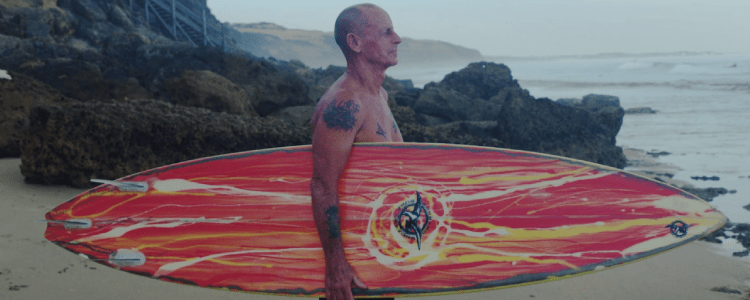
For the most part, Belly of the Beast maintains a light, jovial tone while it’s also giving you this deep rich history of the small town of Torquay but when the time comes for them to get serious and talk about mental health issues and the passing of a few big-time legends it pulls back the laughs and focusses incredibly well in a way that doesn’t feel forced. It’s got a great naturalistic feeling to the delivery, every one of the interviewees just fits together well and manages to make a truly compelling history come alive.
Where Belly of the Beast sets itself apart from other documentaries about the history of certain locations is with the personality that it presents. Thanks in no small part to the very Ocker Aussie sensibility that oozes from every pore of every person being interviewed, there’s just boundless energy and charm in the stories being told with regular moments of genuinely gut-busting laughter brought out by a witty turn of phrase. It makes the film engaging even to those of us who aren’t part of the surfing culture and couldn’t give two shits about surfing. It makes it fascinating no matter what level of interest you actually have in the topic, which is a sign of a truly great documentary.
Belly of the Beast is more than just a Torquay story, it’s the story of culture and capitalism and mental health and the expansion of suburbia into areas it used to never touch. It’s a story of friendships and found families formed on a sandy beach in a hot summer in ‘63. It’s a story about something truly human, a tenacity that runs through this group who were in the right place to ride the wave of culture that came up behind them and picked them up to go on a truly wild ride, one that they’ve recorded for posterity in glorious detail.

 Movie Meister Reviews